
Designing Solution Architecture That Bridges Business and Technology
In our previous posts, we explored how strategic business architecture establishes your transformation “why,” operational business architecture creates your organizational “how,” business process design translates vision into concrete workflows, and requirements management builds bridges between vision and implementation. Now we turn to the fifth critical layer in our architectural framework: Solution Architecture—the blueprint that translates business needs into technical solutions.
The Translation Gap: When Technical Excellence Fails to Deliver Value
Consider this all-too-common scenario: A transformation initiative delivers technically excellent systems—robust, secure, scalable platforms implemented according to best practices. The project meets its technical specifications on time and within budget. Yet business stakeholders are deeply disappointed with the results. The implementation is considered a failure despite its technical quality.
This disconnect reveals a critical gap in most transformation approaches: the absence of effective solution architecture that translates business intent into technical reality without losing meaning in the process. Without this essential translation layer, your transformation risks becoming a game of telephone—where the message that reaches technical implementation bears little resemblance to the business vision that started the journey.
What Is Solution Architecture?
Solution architecture describes, in a platform-independent way, the high-level processes, applications, data, and technology that enable your business architecture. It serves as the essential bridge between what the organization needs (requirements) and how those needs will be technically fulfilled (implementation).
Think of solution architecture as the blueprint that determines whether your technology implementation will truly enable transformation or merely digitize existing processes. This architecture defines not just individual system components but how they work together to create business capabilities that advance strategic objectives.
The most effective solution architectures include multiple views that address different aspects of the transformation puzzle:
- Application Architecture: The individual tools and software applications that comprise the overall solution
- Information Architecture: How data is structured and how users, applications, and services interact with it
- Services Architecture: The independent functions required to meet complex business objectives
- Integration Architecture: How systems connect and communicate to enable end-to-end processes
- Infrastructure Architecture: The shared foundation that supports the entire solution ecosystem
Why Solution Architecture Determines Transformation Success
For transformation initiatives to deliver meaningful value, the gap between business intent and technical implementation must be effectively bridged. Solution architecture creates this bridge in several powerful ways:
1. Translating Business Intent: The Communication Challenge
Business stakeholders and technical teams often speak different languages—using different terminology, focusing on different priorities, and approaching problems from different perspectives. This communication gap frequently results in solutions that meet technical specifications but miss business intent.
Solution architecture serves as the translator between these worlds—ensuring that business needs are expressed in ways technical teams can implement, while technical constraints are communicated in terms business stakeholders can understand. This translation prevents the all-too-common scenario where technical teams build exactly what was specified but not what was actually needed.
2. MaintainingStrategic Alignment: The Business Value Challenge
As transformation initiatives progress from concept to implementation, the connection to strategic objectives often weakens—with tactical decisions gradually steering the effort away from its original purpose. This drift typically happens not through deliberate redirection but through a series of small, seemingly reasonable compromises.
Solution architecture maintains the thread between strategy and implementation—ensuring that technical decisions remain aligned with business purpose. By explicitly connecting technical components to the business capabilities they enable, solution architecture creates accountability for delivering strategic value rather than just technical functionality.
3. Enabling Integration: The End-to-End Challenge
Most significant business processes span multiple systems and organizational boundaries. Without solution architecture, these integration points often become afterthoughts—discovered late in implementation when addressing them becomes costly and disruptive.
Effective solution architecture brings integration to the forefront—identifying where systems must connect and how information must flow across boundaries. This integration focus ensures that your transformation addresses end-to-end business processes rather than optimizing isolated system components.
4. Balancing Present and Future: The Evolution Challenge
Business needs continuously evolve, requiring technology solutions that can adapt to changing requirements. Without solution architecture, implementations often optimize for current requirements at the expense of future flexibility—creating technical debt that constrains subsequent evolution.
Solution architecture balances immediate needs with future possibilities—establishing design principles and patterns that enable adaptation without requiring complete rebuilds. This forward-looking perspective ensures that your technology investment enables ongoing transformation rather than becoming tomorrow’s legacy constraint.
Building Your Solution Architecture
Creating effective solution architecture isn’t about producing perfect diagrams—it’s about establishing the conceptual framework that guides technical implementation. The most successful architectures combine visualization with practical guidance:
Application Architecture: Defining the Technical Landscape
Application architecture identifies the individual tools and software applications that will comprise your overall solution. Unlike a simple inventory of systems, effective application architecture shows how applications relate to each other and to the business capabilities they support.
This architectural view typically includes:
- Application Layering: How applications are organized into logical groups based on their business purpose
- Application Interactions: How applications communicate and share information
- Capability Mapping: Which applications support which business capabilities
- Application Lifecycle: Where each application sits in its evolution from new to legacy
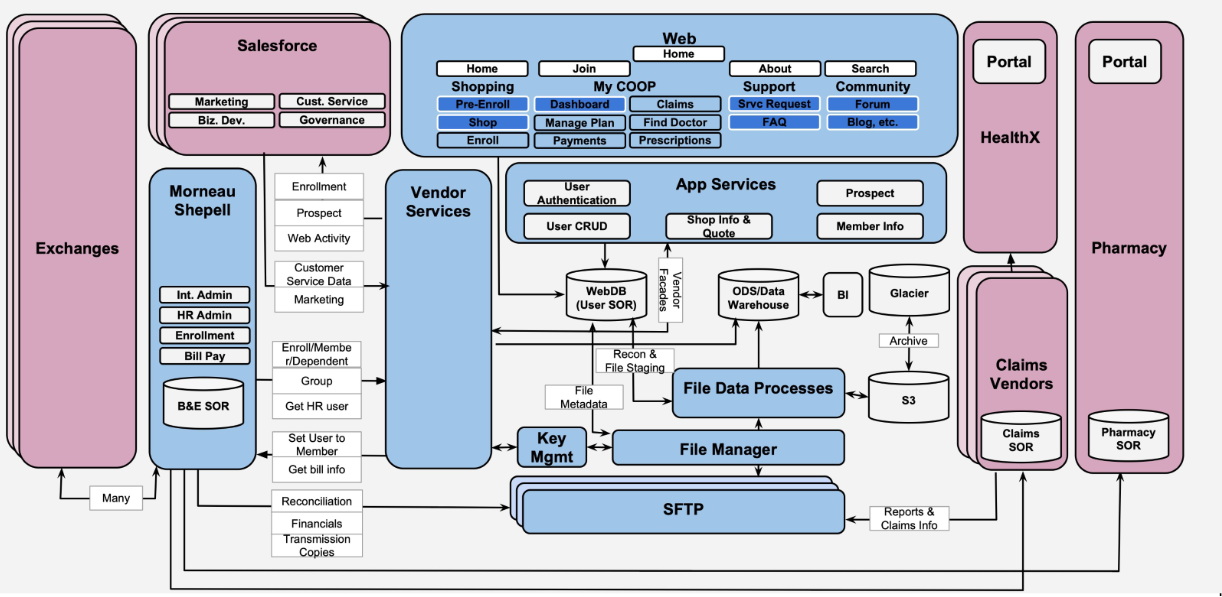
Figure 1: Sample Solutions Architecture
The most effective application architectures balance completeness with clarity—providing enough detail to guide implementation while remaining accessible to business stakeholders.
Information Architecture: Structuring Data for Value
Information architecture defines how data is structured, stored, and accessed across your solution. This architectural view is particularly critical for transformations that aim to improve decision-making, enhance customer experiences, or enable new business models.
Key components of information architecture include:
- Data Domains: The major categories of information your organization manages
- Data Ownership: Who is responsible for maintaining different types of information
- Data Flow: How information moves between systems and processes
- Master Data Management: How you ensure consistency of critical information across systems
- Analytics Framework: How data transforms into insights that drive decisions
Information architecture addresses not just technical data structures but the broader question of how information creates business value—ensuring that your transformation improves not just data storage but data utilization.
Services Architecture: Building for Modularity
Services architecture defines the independent functions that your solution must provide to meet business objectives. This architectural view is particularly important for transformations that require flexibility to address evolving needs.
The most effective services architectures:
- Identify Core Services: The fundamental capabilities that support multiple business processes
- Define Service Boundaries: Where one service ends and another begins
- Establish Service Interfaces: How services communicate with each other and with applications
- Balance Granularity: Creating services that are neither too broad (monolithic) nor too narrow (fragmented)
By organizing functionality into modular services, this architecture enables components to evolve independently—allowing your transformation to adapt incrementally rather than requiring wholesale reimplementation.
Integration Architecture: Connecting the Ecosystem
Integration architecture defines how systems connect to enable end-to-end business processes. This architectural view is essential for transformations that span multiple systems and organizational boundaries.
Key aspects of integration architecture include:
- Integration Patterns: The standard approaches for connecting systems
- Integration Points: Where systems must communicate to support business processes
- Data Transformation: How information is converted as it moves between systems
- Integration Governance: How integration is managed and monitored
Effective integration architecture prevents the fragmentation that occurs when systems are implemented in isolation—ensuring that your transformation creates a cohesive ecosystem rather than a collection of disconnected islands.
Infrastructure Architecture: Establishing the Foundation
Infrastructure architecture defines the shared technology foundation that supports your entire solution. While often focused on technical components, effective infrastructure architecture maintains clear connections to business objectives.
This architectural view typically includes:
- Technology Standards: The approved platforms and technologies
- Scalability Framework: How the infrastructure will accommodate growth
- Security Architecture: How information and systems will be protected
- Disaster Recovery: How service will be maintained in adverse conditions
Infrastructure architecture ensures that your transformation builds on a solid foundation—providing the reliability, security, and scalability that business operations require.
Collaborative Development: Building Shared Understanding
Like other architectural layers, solution architecture should be developed through collaborative engagement across business and technical perspectives. This collaboration ensures that the architecture reflects both business aspirations and technical realities.
The most effective development process follows these steps:
1. Business Architecture Alignment
Begin by revisiting the strategic, operational, and process architectures established in earlier phases. This alignment ensures that solution architecture directly supports business objectives rather than pursuing technical excellence for its own sake.
The key questions this alignment should address include:
- Which business capabilities require the strongest technical support?
- What integration points are most critical for end-to-end processes?
- Which architectural components create strategic differentiation versus operational foundation?
- What principles should guide technical design decisions?
2. Current State Assessment
Evaluate your existing technical landscape—identifying which components can be leveraged, which must be replaced, and which should be integrated with new solutions. This assessment creates a realistic starting point for transformation rather than assuming a greenfield implementation.
Look particularly for:
- Legacy Constraints: Existing systems that limit transformation options
- Technical Debt: Areas where previous implementations constrain future evolution
- Integration Challenges: Points where connecting systems will be particularly difficult
- Architectural Strengths: Existing components that provide solid foundation for transformation
This assessment prevents the common trap of designing ideal solutions that can’t be practically implemented in your actual environment.
3. Future State Definition
Create a comprehensive view of your target solution architecture—showing how applications, information, services, integration, and infrastructure will work together to enable business capabilities. This future state serves as the north star that guides implementation efforts.
The most effective future states:
- Balance Aspiration with Realism: Creating a vision that stretches beyond current limitations without becoming impractical
- Prioritize Components: Distinguishing between essential elements and nice-to-have enhancements
- Address Multiple Timeframes: Showing both near-term implementation steps and longer-term evolution
- Maintain Business Connections: Explicitly linking technical components to the business capabilities they enable
This future state definition provides the destination for your transformation journey—ensuring that tactical implementation decisions advance your strategic direction.
4. Transition Planning
Develop a practical approach for moving from current state to future state—identifying implementation phases, dependencies, and critical path elements. This transition planning bridges the gap between architectural vision and practical execution.
Effective transition planning addresses questions like:
- What architectural components should be implemented first to create a solid foundation?
- Which implementations will deliver the greatest business value earliest?
- What technical dependencies must be addressed before specific capabilities can be delivered?
- How will the organization manage simultaneous operation of legacy and new systems during transition?
This planning ensures that your architecture drives actual implementation rather than remaining a theoretical exercise.
Making Solution Architecture Work in Practice
To ensure your solution architecture becomes a practical guide rather than a static document:
1. Focus on Business Capabilities, Not Just Technical Components
Frame architectural discussions around the business capabilities being enabled rather than just the technical components being implemented. This business focus ensures that architecture serves transformation objectives rather than technical interests.
2. Create Multiple Views for Different Audiences
Develop different architectural views that address the needs of diverse stakeholders. Business leaders need high-level views that show how technology enables strategic objectives. Technical teams need detailed views that guide implementation decisions. Creating multiple perspectives ensures that architecture serves all audiences.
3. EstablishArchitecture Governance
Create mechanisms for maintaining architectural integrity throughout implementation. This governance ensures that tactical decisions remain aligned with architectural direction—preventing the gradual drift that can undermine transformation objectives.
4. Treat Architecture as a Living Framework
Continuously refine your solution architecture based on implementation experience and changing business needs. This evolution ensures that architecture remains relevant as your transformation progresses—creating a virtuous cycle where execution enhances architectural understanding.
Looking Ahead: From Solution to Technical Architecture
While solution architecture provides the essential blueprint for your transformation, implementing this vision requires detailed technical specifications. In our next post, we’ll explore the sixth layer in our architectural framework: Technical Architecture.
We’ll examine how to translate solution architecture into detailed technical designs that guide implementation—creating the engineering specifications that make your transformation vision buildable.
This article is the fifth in our “Blueprint for Workflow Design and Business Process Analysis” series—a journey through the architectural layers that transform strategic vision into operational reality.
How has your organization approached solution architecture in transformation efforts? Have you found effective ways to bridge the gap between business requirements and technical implementation? Share your experiences in the comments below.