
Throughout this series, we’ve explored the architectural layers that transform strategic vision into operational reality: strategic business architecture that establishes your “why,” operational business architecture that creates your organizational “how,” business process design that translates vision into concrete workflows, requirements management that builds bridges to implementation, solution architecture that blueprints technical capabilities, and technical architecture that provides detailed specifications. Now we turn to the final and perhaps most critical element: The Unified Approach—the integration framework that weaves these layers into a cohesive whole.
The Integration Challenge: When Excellence in Parts Doesn’t Create Excellence in Whole
Consider this all-too-common scenario: An organization develops impressive artifacts for each architectural layer. The strategic vision inspires. The operational maps clarify. The process designs innovate. The requirements connect. The solution architecture enlightens. The technical specifications guide. Yet somehow, the resulting transformation feels fragmented—with each element excellent in isolation but failing to create coherent change.
This disconnect reveals the fundamental challenge of transformation: Excellence in individual architectural layers doesn’t automatically create excellence in the whole. Without explicit integration mechanisms, architectural layers can evolve in different directions—leading to strategic visions disconnected from technical implementation, processes misaligned with organizational capabilities, and requirements that don’t reflect process realities.
What Is the Unified Approach?
The unified approach creates integration across architectural layers—establishing the vertical traceability, horizontal alignment, and governance mechanisms that transform separate elements into a coherent whole. It’s not another architectural layer but rather the methodology that connects existing layers into an integrated framework for transformation.
Think of the unified approach as the architectural master plan that ensures all elements work together to create coherent change. This approach addresses not just individual components but the critical connections between them—creating a transformation framework greater than the sum of its parts.
The most effective unified approaches address several critical dimensions:
- Vertical Traceability: How elements connect from strategy through implementation
- Horizontal Alignment: How components align across organizational boundaries
- Temporal Coordination: How initiatives sequence and evolve over time
- Governance Integration: How decision-making maintains architectural coherence
Why the Unified Approach Determines Transformation Success
For transformation initiatives to deliver coherent change rather than isolated improvements, architectural layers must work together as an integrated system. The unified approach creates this integration in several powerful ways:
1. Creating Vertical Traceability: The Connection Challenge
Without explicit vertical connections, architectural layers often drift apart as they evolve—creating the all-too-common gap between strategic vision and technical implementation. Business leaders wonder why technology doesn’t deliver promised outcomes, while technical teams question why business expectations seem disconnected from implementation realities.
The unified approach establishes explicit traceability from strategy to implementation—creating visible connections that show how each technical component relates to business processes, how those processes support operational capabilities, and how those capabilities advance strategic objectives. This traceability ensures that every architectural element remains connected to your transformation purpose.
Consider a customer experience transformation that aims to create seamless multichannel interactions. Vertical traceability would show how specific technical services (technical architecture) implement integration capabilities (solution architecture) that fulfill cross-channel requirements (requirements management) that enable seamless customer journeys (process design) that deliver operational continuity (operational architecture) that creates competitive differentiation (strategic architecture). This connected chain ensures that technical decisions remain aligned with strategic intent.
2. Ensuring Horizontal Alignment: The Coordination Challenge
Transformations typically span multiple business functions, each with its own objectives, processes, and systems. Without horizontal alignment, these functions often optimize locally at the expense of end-to-end effectiveness—creating fragmented experiences and inefficient operations.
The unified approach establishes mechanisms for horizontal alignment—ensuring that architectural elements work together across organizational boundaries. This alignment prevents the common scenario where finance, operations, customer service, and other functions implement changes that satisfy their specific needs but create disconnected customer experiences and inefficient operations.
3. Managing Temporal Evolution: The Roadmap Challenge
Transformations unfold over time, with different elements implemented in different phases. Without a unified approach to sequencing, initiatives often proceed based on local priorities rather than overall effectiveness—leading to partially implemented capabilities and unrealized benefits.
The unified approach creates integrated transformation roadmaps—sequencing initiatives based on dependencies and impact rather than functional convenience. This coordinated evolution ensures that your transformation builds momentum through early wins while systematically developing the capabilities required for long-term success.
4. Integrating Governance: The Decision Challenge
Different architectural layers typically involve different stakeholders and decision processes. Without integrated governance, these separate decision streams can create conflicting directions and incompatible choices—leading to architectural fragmentation despite well-intentioned individual decisions.
The unified approach establishes holistic governance that maintains architectural coherence across layers and over time. This integrated decision-making ensures that choices in one area consider implications for other areas—creating a transformation that evolves as a coherent whole rather than disconnected parts.
Building Your Unified Approach
Creating an effective unified approach isn’t about developing new documentation but establishing the connections, processes, and capabilities that integrate existing architectural layers. The most successful approaches combine several key elements:
Traceability Framework: Connecting the Vertical Layers
The cornerstone of the unified approach is a traceability framework that explicitly connects elements across architectural layers. This framework doesn’t replace layer-specific documentation but adds the critical links that show how elements relate across layers.
The most effective traceability frameworks include:
- Strategic-to-Operational Mapping: How operational capabilities support strategic objectives
- Operational-to-Process Alignment: How processes implement operational capabilities
- Process-to-Requirements Connections: How requirements enable process capabilities
- Requirements-to-Solution Traceability: How solution components fulfill requirements
- Solution-to-Technical Mapping: How technical specifications implement solution capabilities
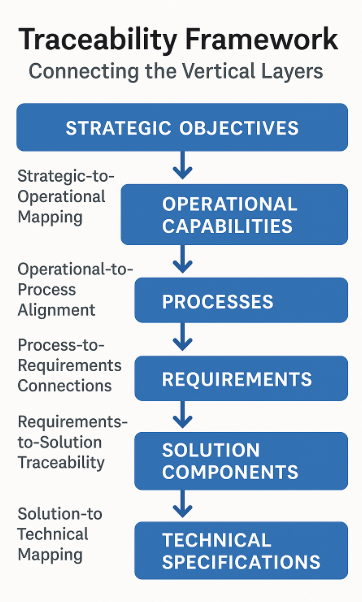
Figure 1: Sample Traceability Framework
This traceability doesn’t just document connections—it creates accountability for maintaining alignment as architectural elements evolve.
Cross-Functional Integration: Aligning the Horizontal Dimension
Beyond vertical connections, the unified approach must address horizontal alignment across organizational functions. This integration ensures that architectural elements work together across boundaries to create cohesive capabilities.
Key aspects of cross-functional integration include:
- End-to-End Process Governance: Oversight mechanisms that maintain process integrity across functional boundaries
- Cross-Functional Requirements Management: Approaches that balance functional needs with horizontal integration
- Enterprise Data Management: Practices that ensure consistent information across organizational boundaries
- Integration Architecture: Standards and patterns that enable system interaction across functions
This horizontal integration prevents the functional silos that fragment transformation efforts—ensuring that your organization changes as a coherent whole rather than disconnected parts.
Roadmap Integration: Coordinating the Temporal Dimension
The unified approach must address not just what changes but when and in what sequence those changes occur. This temporal coordination ensures that transformation initiatives build on each other rather than proceeding independently.
Effective roadmap integration includes:
- Dependency Mapping: Identifying how initiatives in different architectural layers depend on each other
- Capability Sequencing: Planning the logical order for developing new business and technical capabilities
- Phase Definition: Creating coherent implementation phases that deliver meaningful business value
- Milestone Alignment: Establishing cross-architectural checkpoints that confirm integrated progress
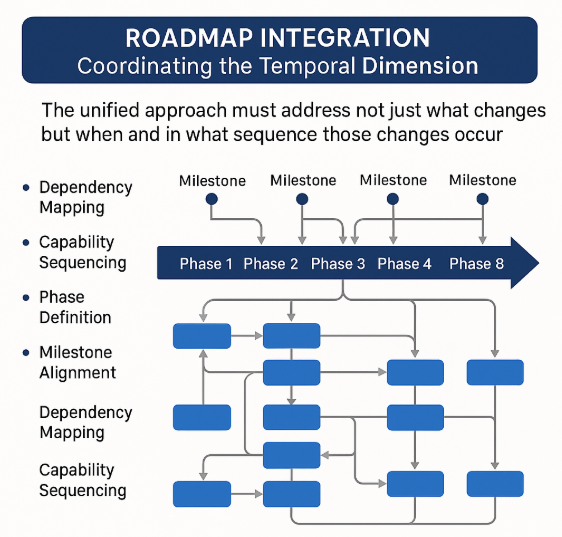
Figure 2: Sample Roadmap Integration
This roadmap integration ensures that your transformation unfolds in a coherent sequence—delivering progressive value while systematically building towards your strategic vision.
Integrated Governance: Maintaining Architectural Coherence
The unified approach requires governance mechanisms that maintain alignment across architectural layers and throughout implementation. This governance ensures that decisions in one area consider implications for other areas—preventing the drift that fragments transformation efforts.
The most effective governance approaches include:
- Architectural Review Boards: Cross-functional forums that ensure changes across layers maintain alignment with the overall transformation intent.
- Decision Rights Framework: Clear definitions of who makes which decisions across architectural layers
- Architectural Principles: Shared guidelines that apply across all layers and guide decision-making
- Impact Analysis Processes: Standard approaches for evaluating how changes in one area affect others
This integrated governance doesn’t eliminate specialized decision processes for different architectural layers but ensures that these processes connect through mechanisms that maintain overall coherence.
Organizational Capabilities: Making the Unified Approach Sustainable
The unified approach isn’t just a methodology—it requires specific organizational capabilities that sustain architectural integration over time. Developing these capabilities is essential for transformations that create lasting change rather than temporary alignment.
Enterprise Architecture Capability
At the core of the unified approach lies enterprise architecture—the organizational function that maintains integration across architectural layers. Effective enterprise architecture serves not as a documentation factory but as the connective tissue that links strategy, operations, processes, and technology.
The most successful enterprise architecture capabilities:
- Balance Business and Technical Focus: Maintaining equal emphasis on business and technical architecture
- Combine Strategic and Tactical Perspectives: Addressing both long-term direction and immediate implementation
- Emphasize Integration Over Documentation: Focusing on connections between elements rather than exhaustive documentation
- Support Decision-Making: Providing the context and guidance that enables better choices
This capability ensures that architectural integration becomes an ongoing practice rather than a one-time exercise.
Cross-Functional Collaboration Mechanisms
Beyond formal architecture, the unified approach requires mechanisms that enable collaboration across organizational boundaries. These mechanisms create the shared understanding essential for integrated transformation.
Effective collaboration mechanisms include:
- Communities of Practice: Cross-functional groups that share knowledge and develop integrated approaches
- Integrated Planning Processes: Planning approaches that consider interdependencies across functions
- Shared Visualization Tools: Methods for making complex relationships visible and understandable
- Collaborative Design Workshops: Structured sessions that bring diverse perspectives together to solve integration challenges
These mechanisms supplement formal governance with the informal collaboration essential for addressing the complex challenges that span architectural boundaries.
Continuous Learning Approaches
The unified approach requires continuous refinement based on implementation experience. This learning ensures that architectural integration evolves as your understanding of transformation challenges deepens.
The most effective learning approaches include:
- Architecture Retrospectives: Establish continuous learning rituals like retrospectives and feedback loops to surface integration gaps and evolve your architecture as you go
- Cross-Layer Learning Forums: Events where stakeholders from different architectural layers share perspectives
- Pattern Evolution: Systematic approaches for refining architectural patterns based on experience
These learning mechanisms ensure that your unified approach becomes more effective over time—creating a virtuous cycle where execution experience enhances architectural integration.
The Unified Approach in Practice: From Theory to Action
To make the unified approach work in your organization:
1. Start with Connection, Not Perfection
Focus first on establishing connections between existing architectural elements rather than creating perfect artifacts in each layer. These connections often reveal gaps and inconsistencies that would otherwise remain hidden—focusing subsequent efforts on the areas that most need attention.
2. Create Visual Integration Tools
Develop visual representations that show relationships across architectural layers. These visualizations make complex connections understandable to diverse stakeholders—creating shared understanding that text-heavy documentation rarely achieves.
3. EstablishIntegration Rituals
Create regular activities that maintain architectural connections as elements evolve. These rituals might include cross-layer reviews, impact analysis sessions, or alignment workshops—ensuring that integration remains an ongoing practice rather than a one-time exercise.
4. Build Integration Skills
Develop capabilities in boundary-spanning roles that connect different architectural layers. These integrators—whether they have formal enterprise architecture titles or not—serve as translators between different perspectives, ensuring that each architectural layer remains connected to the others.
The Sustainable Transformation: Beyond Projects to Capabilities
Beyond specific methodologies, the unified approach represents a fundamental shift in how organizations approach transformation—moving from isolated projects to integrated capabilities. This shift creates transformations that don’t just implement new technologies or redesign specific processes but build the organizational muscles that enable continuous evolution.
The most successful transformations using the unified approach:
- Create Reusable Patterns: Developing standard approaches that apply across multiple initiatives
- Build Architectural Thinking: Cultivating an organizational mindset that naturally considers integration
- Establish Learning Systems: Creating mechanisms that systematically capture and apply transformation lessons
- Develop Integrative Leadership: Building leaders who naturally think across boundaries and layers
These organizational capabilities ensure that your transformation doesn’t just create temporary change but establishes the foundation for ongoing evolution—allowing your organization to continuously adapt as business conditions and technologies evolve.
Conclusion: The Blueprint for Effective Transformation
As we conclude this series on workflow design and business process analysis, the unified approach reminds us that transformation success ultimately depends not on individual architectural elements but on how those elements work together to create coherent change.
By establishing vertical traceability from strategy to implementation, horizontal alignment across organizational boundaries, temporal coordination through integrated roadmaps, and coherent governance across architectural layers, the unified approach transforms separate excellences into collective impact.
True integration requires more than coordination—it takes deliberate methodology, strong connective tissue, and leadership that looks across layers, not just within them. But the rewards are substantial: transformations that deliver on their strategic promise rather than fragmenting into disconnected initiatives.
As you apply these architectural frameworks in your own transformation journey, remember that the most beautiful blueprint is worthless unless it can be built—and the most elegant building is useless unless it serves its intended purpose. The unified approach ensures that your architectural layers work together to create not just impressive artifacts but meaningful change.
This article concludes our “Blueprint for Workflow Design and Business Process Analysis” series—a journey through the architectural layers that transform strategic vision into operational reality.
How has your organization approached architectural integration in transformation efforts? Have you found effective ways to maintain connections between strategy, operations, processes, requirements, and technology? Share your experiences in the comments below.