
In our previous posts, we explored the architectural layers that establish why your transformation matters, how your organization creates value, which processes require redesign, what requirements must be fulfilled, and which solution components enable your business capabilities. Now we turn to the sixth critical layer in our architectural framework: Technical Architecture—the detailed specifications that transform abstract vision into buildable reality.
From Concept to Construction: The Implementation Challenge
Imagine trying to construct a skyscraper using only conceptual drawings—no structural engineering plans, no wiring schematics, no technical details. Even with a compelling vision, the outcome would likely be flawed. That’s precisely the risk organizations face when they attempt to leap from solution architecture into implementation without a detailed technical blueprint.
The gap between solution concept and technical implementation creates predictable problems:
- Mid-project redesigns when technical teams discover that conceptual approaches aren’t practically implementable
- Integration challenges that emerge late in development when connecting components proves more complex than anticipated
- Performance and scalability issues that become apparent only after implementation, requiring costly rework
- Security vulnerabilities introduced through inconsistent approaches across technical components
Technical architecture closes this gap by providing the detailed specifications that make your transformation vision constructible—translating what you want to build into how it will actually be built.
What Is Technical Architecture?
Technical architecture describes the physical implementation of technology—the detailed design specifications that guide development teams as they build, configure, and integrate systems. While solution architecture focuses on platform-independent capabilities, technical architecture addresses the specific technologies, products, standards, and patterns that will realize those capabilities.
Think of technical architecture as the engineering blueprints that complement architectural drawings—providing the detailed specifications that ensure a structure isn’t just beautiful but also stable, functional, and buildable. This architecture defines not just what should be built but precisely how it should be constructed.
The most effective technical architectures include detailed documentation across several critical domains:
- Platform Specifications: The specific technologies and products that will implement solution components
- Domain Models: Detailed data structures and relationships that support business information requirements
- Interface Definitions: Specific API designs, message formats, and integration patterns
- Deployment Models: How components will be installed, configured, and operated
- Security Mechanisms: Detailed controls that protect information and systems
Why Technical Architecture Determines Implementation Success
For transformation initiatives to move from concept to reality, solution vision must translate into technical specifications. Technical architecture creates this translation in several powerful ways:
1. Making the Abstract Concrete: The Specification Challenge
Solution architecture necessarily operates at a conceptual level—describing capabilities and connections without specifying exactly how they will be implemented. This abstraction is valuable for maintaining focus on business needs, but it leaves significant ambiguity for implementation teams.
Technical architecture resolves this ambiguity—converting abstract capabilities into concrete specifications that development teams can directly implement. This conversion prevents the misinterpretations and inconsistent approaches that occur when multiple teams interpret high-level concepts differently.
Consider an integration requirement between two systems. Solution architecture might specify that the systems need to exchange customer information in real-time. Technical architecture defines precisely how this exchange will occur—specifying the API design, message format, authentication mechanism, error handling approach, and performance requirements. This specificity ensures that development teams build components that work together seamlessly rather than requiring extensive rework to reconcile different interpretations.
2. Revealing Dependencies: The Coordination Challenge
Complex implementations involve multiple technical components developed by different teams on different timelines. Without detailed technical architecture, the dependencies between these components often remain hidden until integration testing—when discovering them creates costly delays and rework.
Technical architecture makes dependencies explicit—identifying where components must synchronize, which elements must be delivered before others can proceed, and how changes in one area affect other parts of the solution. This visibility enables effective planning and coordination that prevents the cascading delays that plague many transformation initiatives.
3. Enabling Scenario Planning: The Decision Challenge
Throughout implementation, teams face countless technical decisions that affect system capabilities, performance, security, and maintainability. Without technical architecture, these decisions often occur under pressure with limited information—resulting in suboptimal choices that constrain future options.
Technical architecture facilitates scenario planning—allowing teams to evaluate different technical approaches before committing to implementation. This advance consideration ensures that technical decisions reflect deliberate choices rather than expedient compromises, creating solutions that better balance immediate needs with long-term sustainability.
4. Building for Evolution: The Sustainability Challenge
Business needs continuously evolve, requiring technology solutions that can adapt without extensive rebuilding. Without technical architecture, implementations often prioritize immediate functionality over long-term flexibility—creating rigid solutions that resist modification.
Technical architecture establishes the patterns, interfaces, and standards that enable sustainable evolution—ensuring that systems can adapt to changing requirements without complete reconstruction. This forward-looking approach prevents the technical debt that accumulates when immediate implementation convenience takes precedence over long-term adaptability.
Building Your Technical Architecture
The relationship between solution and technical architecture is not sequential duplication—it is progressive refinement. Where solution architecture frames the capabilities and integration points conceptually, technical architecture specifies the physical tools, configurations, and patterns that will bring them to life. This is the difference between envisioning a modular kitchen layout and specifying the wiring, plumbing, and cabinetry that will make it usable.
Creating effective technical architecture isn’t about producing perfect documentation before any implementation begins. Rather, it’s about establishing enough technical specificity to guide implementation while maintaining flexibility for refinement as development progresses. The most successful architectures combine detailed specifications with practical guidance:
Platform Architecture: Defining the Technical Foundation
Technical architecture identifies not only which technologies will be used, but also how they interact as a system—ensuring interoperability, scalability, and long-term sustainability.
This architectural domain typically includes:
- Technology Standards: The approved platforms, languages, frameworks, and tools
- Product Selections: The specific vendor products that will implement solution components
- Version Specifications: The particular releases and configurations to be used
- Deployment Models: How platforms will be installed, configured, and operated
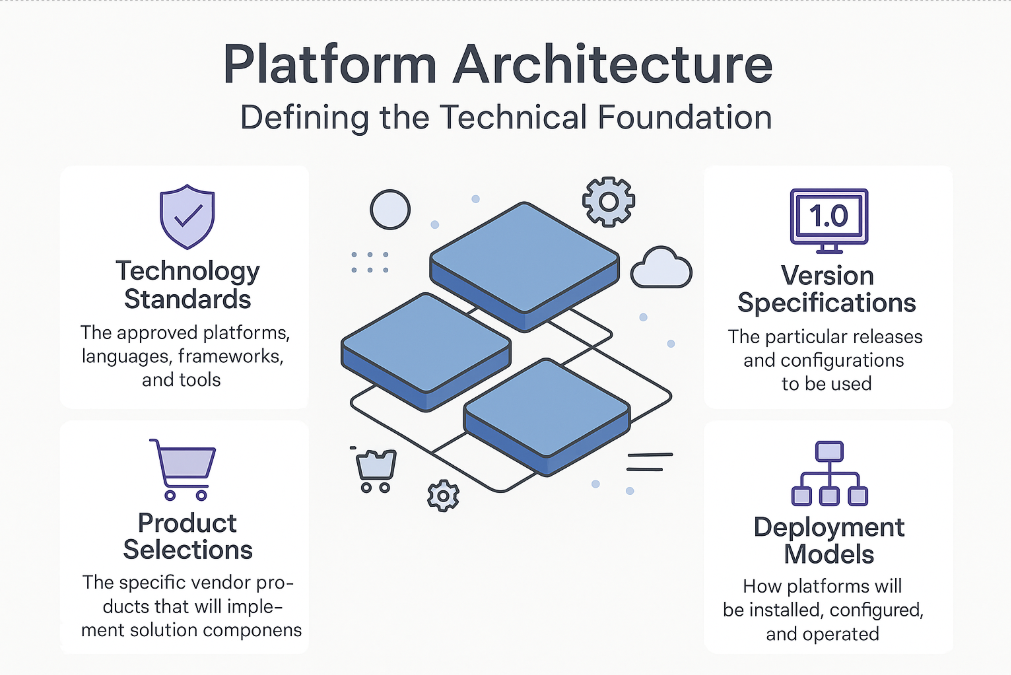
Figure 1: Sample Technical Architecture
The most effective platform architectures balance standardization with specialization—creating consistency where appropriate while allowing targeted solutions for unique requirements.
Data Architecture: Structuring Technical Information
Data Architecture defines the detailed data structures and relationships that support business information requirements. This architectural domain translates conceptual information models into specific technical implementations.
Key components of Data Architecture include:
- Logical Data Models: The entities, attributes, and relationships that comprise your information domain
- Physical Data Models: The specific database schemas, tables, and fields that implement logical models
- Data Mapping: How information transforms as it moves between different systems
- Data Quality Rules: The specific validations and constraints that ensure information integrity
Data Architecture addresses not just data storage but the entire information lifecycle—ensuring that your transformation creates consistent, accessible, and reliable information resources.
Interface Architecture: Enabling Technical Communication
Interface architecture defines how technical components communicate—specifying the APIs, message formats, and integration patterns that enable system interaction. This architectural domain is critical for ensuring that independently developed components work together seamlessly.
The most effective interface architectures include:
- API Specifications: Detailed definitions of service interfaces including methods, parameters, and return values
- Message Formats: The structure and content of information exchanged between systems
- Integration Patterns: Standard approaches for common integration scenarios
- Error Handling: How systems respond to and recover from communication failures
By standardizing communication mechanisms, interface architecture prevents the incompatibilities that typically emerge when components are developed in isolation.
Deployment Architecture: Planning Technical Implementation
Deployment architecture defines how solution components will be installed, configured, and operated in production environments. This architectural domain bridges development and operations—ensuring that what gets built can be effectively deployed and managed.
Key aspects of deployment architecture include:
- Environment Specifications: The technical infrastructure required for development, testing, and production
- Deployment Procedures: How components move from development to production
- Configuration Management: How different environments are maintained and synchronized
- Operational Support: The monitoring, backup, and recovery processes that maintain system health
- Deployment architecture ensures that your transformation doesn’t just create technical components but establishes the operational framework that keeps those components functioning reliably.
Security Architecture: Protecting Technical Assets
Security architecture defines how your solution protects information and systems from unauthorized access, modification, or disruption. This architectural domain is increasingly critical as transformation initiatives expose more capabilities through digital channels.
This architectural domain typically includes:
- Authentication Mechanisms: How users and systems establish their identity
- Authorization Controls: How access to functionality and information is managed
- Data Protection: How sensitive information is secured both in transit and at rest
- Audit Capabilities: How security-relevant events are recorded and monitored
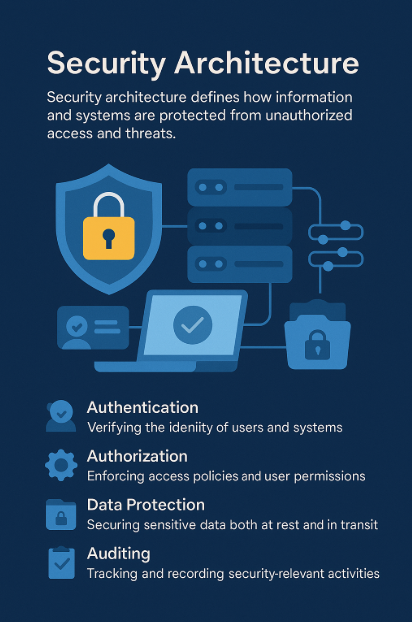
Figure 2: Security Architecture
Effective security architecture balances protection with usability—creating controls that safeguard assets without unnecessarily impeding legitimate use.
Collaborative Development: Balancing Specification with Flexibility
Technical architecture requires detailed specifications, but creating every detail before implementation begins is neither practical nor desirable. The most effective approach balances upfront specification with ongoing refinement through collaborative development.
This balanced approach typically follows these steps:
1. Solution Architecture Alignment
Begin by revisiting the solution architecture established in earlier phases. This alignment ensures that technical specifications support solution objectives rather than creating divergent implementation paths.
The key questions this alignment should address include:
- Which solution components require the most detailed technical specification?
- What technical standards and patterns should apply across all components?
- Which technical decisions have the greatest impact on solution capabilities?
- What technical constraints must be accommodated in the implementation?
2. Critical Path Specification
Focus initial technical architecture on the elements that form the critical path of your implementation—the components, interfaces, and dependencies that must be established before other development can proceed. This prioritized approach ensures that the most important specifications are available when needed.
Look particularly for:
- Foundation Components: Technical elements that support multiple solution capabilities
- Complex Interfaces: Integration points where detailed specification prevents misalignment
- Performance-Critical Elements: Components where technical design significantly affects system responsiveness
- Security-Sensitive Areas: Functions that require specific protection mechanisms
This prioritization prevents the analysis paralysis that occurs when teams attempt to specify everything before beginning implementation.
3. Progressive Elaboration
Develop technical architecture progressively as implementation advances—adding detail as development teams encounter specific design questions. This elaboration ensures that technical specifications address actual implementation needs rather than theoretical possibilities.
The most effective progressive elaboration:
- Anticipates Design Questions: Providing specifications before development teams need them
- Learns From Implementation: Refining architectural guidance based on development experience
- Maintains Consistency: Ensuring that incremental specifications align with overall architectural direction
- Documents Decisions: Capturing the rationale behind technical choices for future reference
This approach creates a virtuous cycle where implementation experience enhances architectural understanding, which in turn improves implementation guidance.
4. Technical Governance
Establish mechanisms for maintaining technical alignment throughout implementation—ensuring that development decisions remain consistent with architectural direction. This governance prevents the gradual drift that can undermine architectural integrity.
Effective technical governance includes:
- Architecture Reviews: Regular evaluations of implementation against architectural specifications
- Design Authority: Clear decision-making processes for technical questions
- Pattern Development: Evolution of standard approaches based on implementation experience
- Technical Debt Management: Explicit tracking and remediation of architectural compromises
This governance ensures that your technical architecture remains a living framework that guides implementation rather than a static document that becomes increasingly irrelevant as development progresses.
Making Technical Architecture Work in Practice
To ensure your technical architecture effectively guides implementation rather than gathering dust in documentation repositories:
1. Focus on Decisions, Not Just Documentation
Frame technical architecture as guidance for implementation decisions rather than comprehensive documentation requirements. This decision focus ensures that architecture addresses the questions that actually arise during development rather than attempting to document every technical detail.
2. Create Living Artifacts, Not Static Documents
Develop technical architecture as a set of living artifacts that evolve throughout implementation. Wikis, collaborative design tools, and architectural repositories support this evolution better than static documents that quickly become outdated.
3. Engage Development Teams in Architectural Refinement
Involve the teams responsible for implementation in refining and extending technical architecture. This engagement builds both better specifications (informed by practical development knowledge) and stronger commitment to architectural direction.
4. Balance Consistency with Team Autonomy
Create architectural guardrails that ensure consistency in critical areas while allowing development teams autonomy within those boundaries. This balanced approach prevents the rigid standardization that stifles innovation while maintaining the coherence essential for integrated solutions.
Technical Architecture as Decision Support
Ultimately, technical architecture serves as a decision support framework—helping implementation teams make better choices by providing context, constraints, and guidance. The most effective technical architectures:
- Distinguish Between Requirements and Preferences: Clearly indicating which specifications are mandatory and which represent recommended approaches
- Explain Rationale, Not Just Rules: Helping teams understand why particular approaches are specified rather than just what they should do
- Anticipate Evolution: Identifying areas likely to change and establishing patterns that accommodate modification
- Balance Immediate and Long-term Considerations: Helping teams make decisions that address current needs without creating future constraints
By supporting better technical decisions, architecture creates implementations that are not just functional today but sustainable tomorrow—preventing the technical debt that often accompanies rapid transformation.
Looking Ahead: From Technical Architecture to Unified Approach
While each architectural layer we’ve explored serves a specific purpose, their real power comes from how they work together to guide transformation from strategic vision to technical implementation. In our final post, we’ll explore the seventh layer in our architectural framework: The Unified Approach.
We’ll examine how to integrate the diverse architectural layers into a cohesive methodology—creating the governance mechanisms and organizational capabilities that ensure architectural alignment throughout your transformation journey.
This article is the sixth in our “Blueprint for Workflow Design and Business Process Analysis” series—a journey through the architectural layers that transform strategic vision into operational reality.
How has your organization approached technical architecture in transformation efforts? Have you found effective ways to balance detailed specification with implementation flexibility? Share your experiences in the comments below.